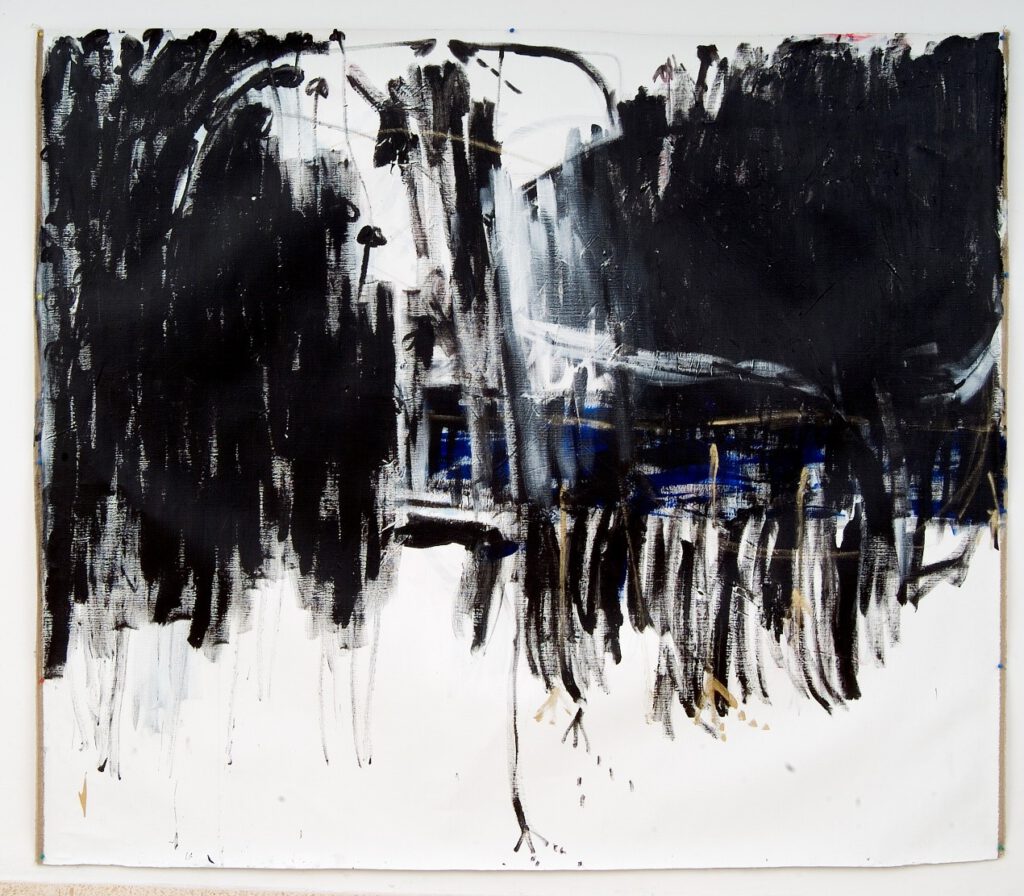
Lea Nickel and Khen Shish: In the Black Distance
More than one straight line stretches between these two painters, and a very long time. So far the two have never met, either in life or on the walls of an exhibition. Lea Nickel (1918-2005) and Khen Shish (b. 1970) – two intense, fleet-footed, vibrant characters – meet up in the arena of painting: one a modernist Action painter, whose art crystallized around this painting movement in real time, namely, in the 1940s and 1950s; the other a post-modernist Gestural artist, part of a contemporary generation exhibiting the most liberated painting in the history of art.
Towards the middle of the last century, Action or Gestural Painting pumped new blood and vitality into the Formalist Abstract, driving the second wave of abstract painting. Lea Nickel – recipient of the 1995 Israel Prize for Art – was one of the exponents of this wave in the Israeli Abstract. The Nickel strain of painting dared to renounce the assets of lyrical abstraction, the sorcery of figuration, the suffocating fetters of adhering to nature, to the model or to practices of painting from observation. Like the American Abstract and French Tachism, her painting aspired to the universal while expressing a whole world of inter-subjective sensations: painting committed to the impulses of the self, providing an unedited record that preserves “mistakes” and impulsive, automatic expressions; painting which is merely the accumulation of the traces of the painterly act itself and of the artist’s sensations during it; painting that celebrates the Romantic approach, which sees the artist as an authentic force of nature engendering not a picture, but an “event”; painting free of “a subject”, devoid of “representation”, albeit not lacking poetic, mental, spiritual “content”.
Khen Shish – a trans-avant-garde and neo-expressionist “soul painter” who has been decorated with numerous awards, including the Eugen Kolb Foundation Award in 2003, the Young Artist Award in 2004 and the Legacy Heritage Fund Prize in 2007 – received a conceptual education mixed with a skeptical attitude towards the act of painting. At the beginning of her artistic career she adopted the Israeli “want of matter”, augmenting it with her own simple, accessible materials, such as spices, stickers, stamps, pieces of double-sided glue, gold leaf, photographs and pictures from the family album, newspapers and magazines. It is these random additions that “color” her art with social bite – but her unconscious and riotous painting gesture still echoes, among others, Aviva Uri, Raffi Lavie, Moshe Gershuni, Tsibi Geva. And Lea Nickel.
Still, to exhibit two artists from two different generations, who operate on different emotional registers, one next to the other – it’s not an obvious choice, however challenging. To emphasize the connection between two bodies of work born under distant circumstances of life and time, works have been selected in which the central motif is the color black: the same black of which Matisse said that if you are a colorist, you will make your presence known even in a simple charcoal drawing. Thus this joint exhibition seeks to explore the affinity between two aesthetic doctrines, and the degree of closeness or distance between the ivory black, functioning as a full partner in Nickel’s colorism – and the carbonic, furnace-y black, functioning as a default choice, an elemental and Romantic given, in Shish’s almost-monochromatic art; to explore the relationship between the modernist gesture, moving under conditions of flow and regimentation in Nickel’s work – and Shish’s post-modernist gesture, surfing among free assemblages of abstraction and representation, reduction and symbol, minimal scratches and poetry.
Open to surprises, Nickel and Shish artlessly play the painting, embellishing it with noises, crashes, rhythmic repetitions, spontaneous deviations, pauses, breaths, meditation and improvisation. The process itself is the subject of art and the painting is a miracle – as both Lea Nickel and Khen Shish would agree, without cynicism or irony.