DISTORTION
Michael Rorberger Painting, photography, processed photography, music, writing, archeology: Renaissance-like eclecticism and humanistic cultural praxis characterize the work of Michael Rorberger – a “mythological” rock music critic, who from 1983 to 2012 wrote about rock performances in the Tel Aviv local newspaper, Ha’Ir, and in its entertainment guide Akhbar Ha’Ir. In 1983 he also edited the rock magazine Volume, and in 1997–98, the weekly music section Re’ashim (“Noises”) of the weekly supplement of Israel’s flagship daily, Haaretz. These days, he pens his own blog – Mickroby, The Blog that Behaves Differently.
Rorberger came to music in the late 1960s, when he was a member of the Third Eye group, which operated as a commune in the apartment of Jacques Mory-Katmor and believed in self-liberation through art. “The apartment had a turntable that played 24 hours a day,” Rorberger recalls. But the urge to paint preceded his writing, and as far back as the early 1970s, Rorberger exhibited paintings at the Engel Gallery in Jerusalem and the Dugit Gallery in Tel Aviv. The canon of rock was constructed through the analogy to modern art, and Rorberger, who espouses Joseph Beuys’s notion that “Everyone is an artist,” is keen on creating in one medium without denying another. From analogue photography to digital photography on a smartphone, from writing to painting, and from the printed newspaper to a blog that strives for personal writing and for renewing the connection between artist and audience, and between object and scene of incidence.
Rorberger’s world moves between the personal space and the common one. The club, like the exhibition space, is the intersection where the longing for the “common sensibility” – the sense which unites the imagined community – is realized. This is the interface between music and photography for Rorberger, who walks around with a camera in the club scene, as an integral part of it. The lens meets an ecstatic experience on stage, capturing facial expressions and body movements in contrasts that reinforce the body’s belonging to the subject and the stage as a space for shared reality. Rorberger directs the visual medium at the sound space of bands and rock icons who performed in clubs in Tel Aviv in the 1980s. Games of proximity and distance, exposures and blurring, demand the acoustics from the image, in an attempt to connect to the heroic rhythm of the image, to get onto the frequency that extends from the auditory sphere to the visual one. Distortion of the body intensifies the subject that projects his body onto the world, its imaginary cohesion in the face of its disintegration.
Distortion – a rock music effect of overloading the circuits of an electric guitar by means of an amplifier or an “effect box” that distorts the sound – appears in Rorberger’s paintings as a symptom of something parasitic, a meme or a foreign body bent on disrupting the image. It migrates from a clean, marker-like, designed and twisting graphic line – a kind of labyrinth – to an expressive and liberated expression in graphite or a brush; from a painting with raw paint on paper or plywood to painting on canvas.
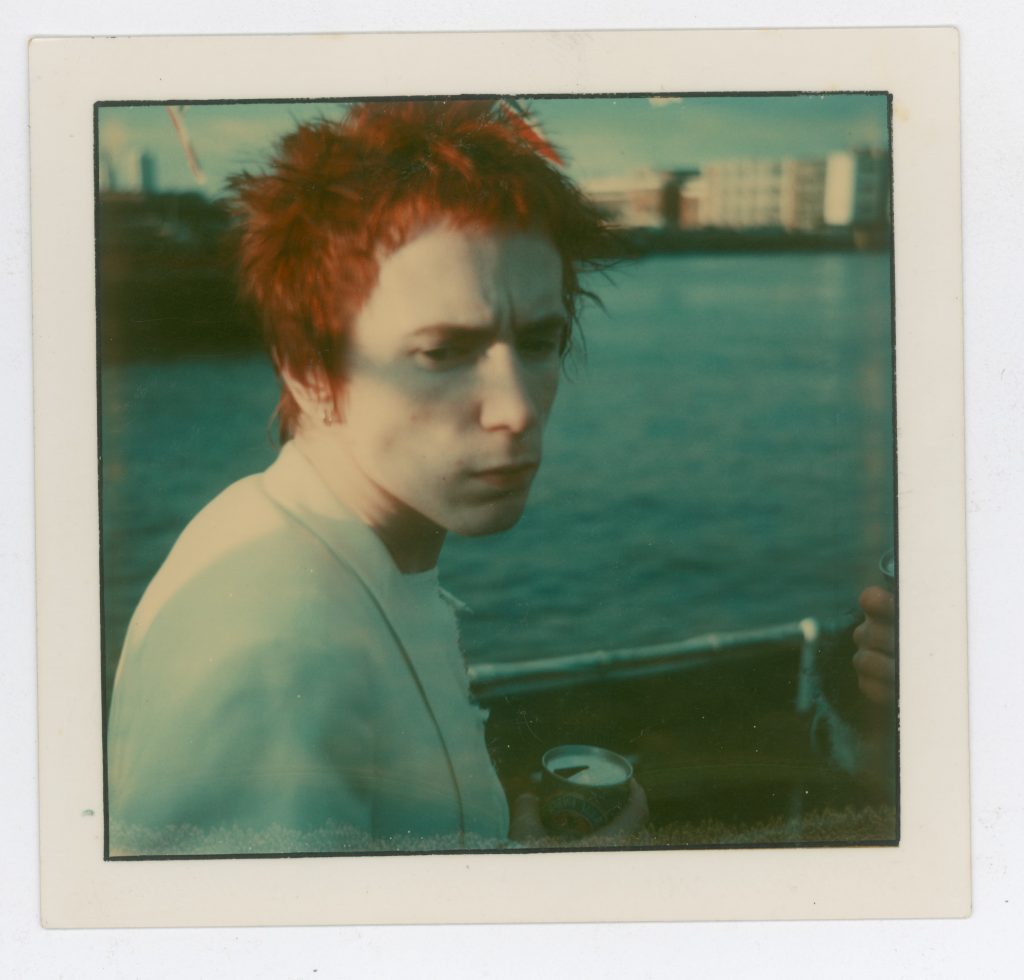
In 1977, Rorberger witnessed the breakthrough of punk in England in a performance of the Sex Pistols on a boat going up the Thames. On returning to Israel at the end of that year, he published the first article in Hebrew about punk music in the newspaper Ha’Olam Hazeh, accompanied by photographs taken with a Polaroid camera. These photographs appear in the exhibition at considerable magnification – as a “photo-transformation” that transpires while realizing the potential of monumental performance – along with “selfies” taken in photo booths, in a bid to capture a moment of human performance, in which Rorberger photographs and performs both himself and the audience.
Rorberger collects records, discs, books, photographs and parts of photographs (“an inventory of mortality”), as well as nameless objects that have been lost or abandoned, out of an anti-hierarchical playful-existential outlook and artistic endeavor that links together objects in an act of freedom and subversion. This is not anarchy, but disengagement and disregard for everything that serves the “external force.” This eclectic artistic pursuit allows for freedom and individuality, a lack of commitment to any particular medium, and even a subversion of the mediums themselves. It is creativity out of curiosity and a love of the pursuit itself, indifferent as to the outcome; an intuitive practice and a playful, kaleidoscopic gaze, marking what refuses to succumb to specification and seeking the cultural, rather than the medium-related, image.
In the labyrinthine space of the museum, the starting point is also the end point, which marks the sampling and the distortion and pits the enjoyment of action and imagination against alienation and detachment, and the ever-changing particular with the universal. New works mingle with works extracted from Rorberger’s archive to reveal traces and details that make it possible to identify pleasure as a meta-language, as well as what motivates the work, yet also what the work is precluded from formulating. The past has also entered Rorberger’s “collection,” who studied archeology at the Hebrew University and took part in archeological digs. The urge to collect and preserve challenges the world of experience and imagination in painting that explores an “inventory list” like a “rescue dig” – a memetic intuition of an indie artist gazing from the fringes of the mainstream and collecting images like vestiges of Chalcolithic rituals and burial rites, which are not symbolic but imprinted as real. Objects that Rorberger – Homo Ludens – would deploy in a Dadaist-psychedelic show are scattered throughout his works like tattoos, in which the tangible distortion and quasi-archaic imagination intermingle in a grotesque mix of pessimism and humor.
The world of distortion is also the world of comics, of caricatures, of playthings and amusement, of symptom and effect, of the crowded and minimal – a pitting of the enigmatic and the primitive against the renewable. Dogs, monsters and reflections of human figures – most of them faceless, blurred, always distorted – merge with symbols that shed their original meaning in favor of the opposite in Rorberger’s “Theater of the Absurd.” Here and there are echoes from Jean-Michel Basquiat’s paintings, or from drawings in the margins of medieval manuscripts, that flow like hallucinations into Hieronymus Bosch’s triptych, Garden of Earthly Delights, that features on Deep Purple’s 1969 vinyl album. A practice of roaming and shifting between disciplines and objects reveals the surface of the exhibition as a space of yearning in which distortion, as a symptom and as an effect, contributes to the division of the senses and reveals the common sensibility.