Ido Bar-El | Sign
In painting everything is a sign. … What would a painting be if not a sign?
– André Malraux quoting Picasso, 1974 –
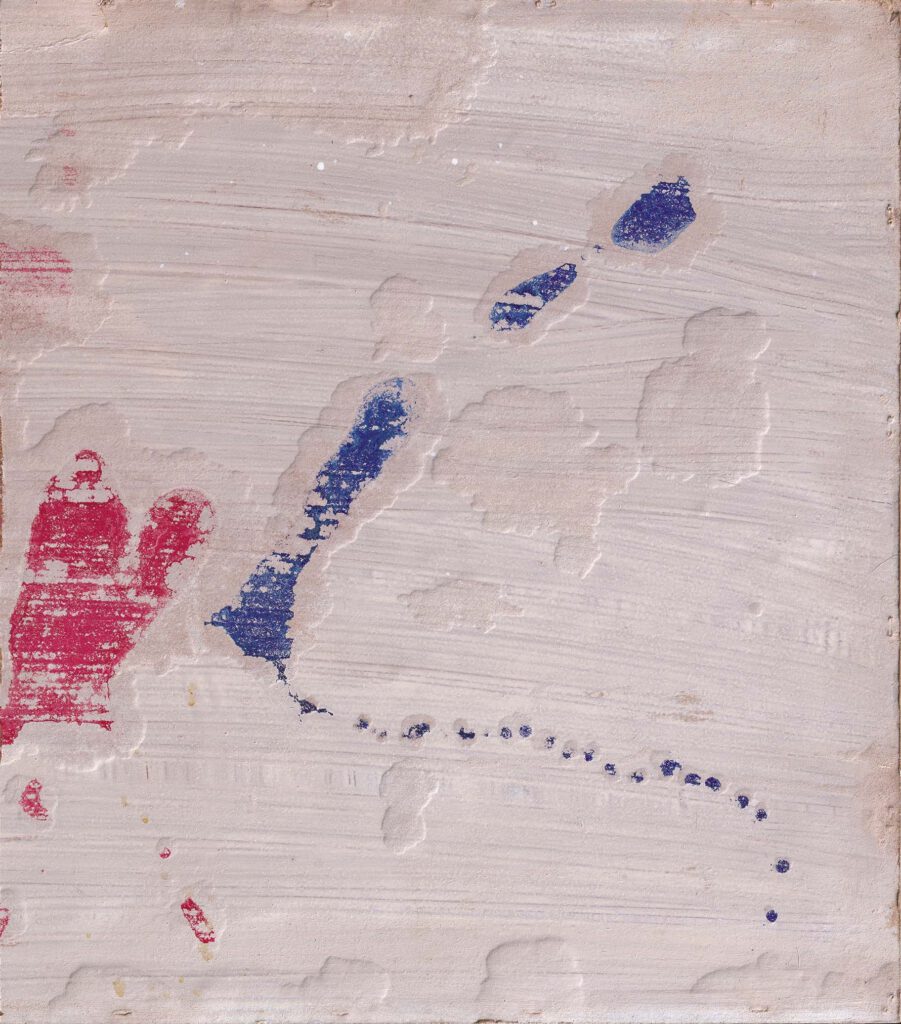
Ashdod Art Museum is happy to present Ido Bar-El’s exhibition, regarding it as an opportunity for a challenging experience: our first presentation of a radical artist—or more accurately: an artist who operates on the line between the radicalism inherent in modernism, and a painterly configuration devoid of hierarchy, postmodernist by nature. The components of the painting presented to us are akin to the constituent elements of a language—a language of signs which are not necessarily traces because they are not always visible, not all of them may be diagnosed, let alone deciphered or identified; a language which is a vast field of presences and absence at one and the same time; a language transpiring between a surface—which is an infrastructure, and a scaffolding, and a found object redeemed from nowhere—and what the eye perceives as a quasi-incidental smearing of paint, a randomly applied stain, a pre-formed world, that has indeed been made void of the chaos, but has not yet reached tranquility. Arie Aroch’s authoritative, moral personality reverberates here from afar.
In 1901 Swiss philosopher Rémy de Gourmont referred to the illusion of spontaneity discernible in Claude Monet’s painting, whose canvases he described as “the work of an instant”—a very specific “instant being,” “that flash” in which “genius collaborated with the eye and the hand.”1 While in the work of the (later) Monet, however, this is a carefully planned process, since his paintings took days to execute, in Bar-El’s case the act is short and immediate; truly instantaneous, as called for by the urge for an immediate, responding practice.
The choice of paintings for the exhibition focused on works from the last decade, deviating from this timeframe only for methodological necessities. In these years the dialectic distinction in Bar-El’s work between surface and marking-painting indeed remains intact, yet virtually any sign of the surface’s specific function (i.e.: a drawer) is eliminated, and the need, if only ironic, of any form that may be deemed representative, is annulled. Yuval Beaton, the curator of the exhibition, and Ido Bar-El himself deliberately selected small groups of works, whose number equals the number of exhibition spaces: each group is characterized by certain shared elements—some formalistic, others unburdened by this necessity in favor of other contexts, such as relations of harmony and disharmony, compression and flux…
Michael Gordon, the catalogue designer and producer, cast a dual gaze into Bar-El’s work: the sequential representation of the totality of works in the exhibition (albeit detached from the dictates of space) is juxtaposed with select details on a one-to-one scale. This remarkably inventive, meticulous catalogue is yet another artist’s book from Michael Gordon’s workshop.
Thanks to all the individuals who took part in this endeavor: thanks to the artist, to Dr. Aïm Deüelle Lüski for his essay in the catalogue, and to the Museum staff, who worked devotedly, despite the hard times, headed by Yuval Beaton, for whom this is the first exhibition he curates since he was entrusted with the position of artistic director of the Museum.