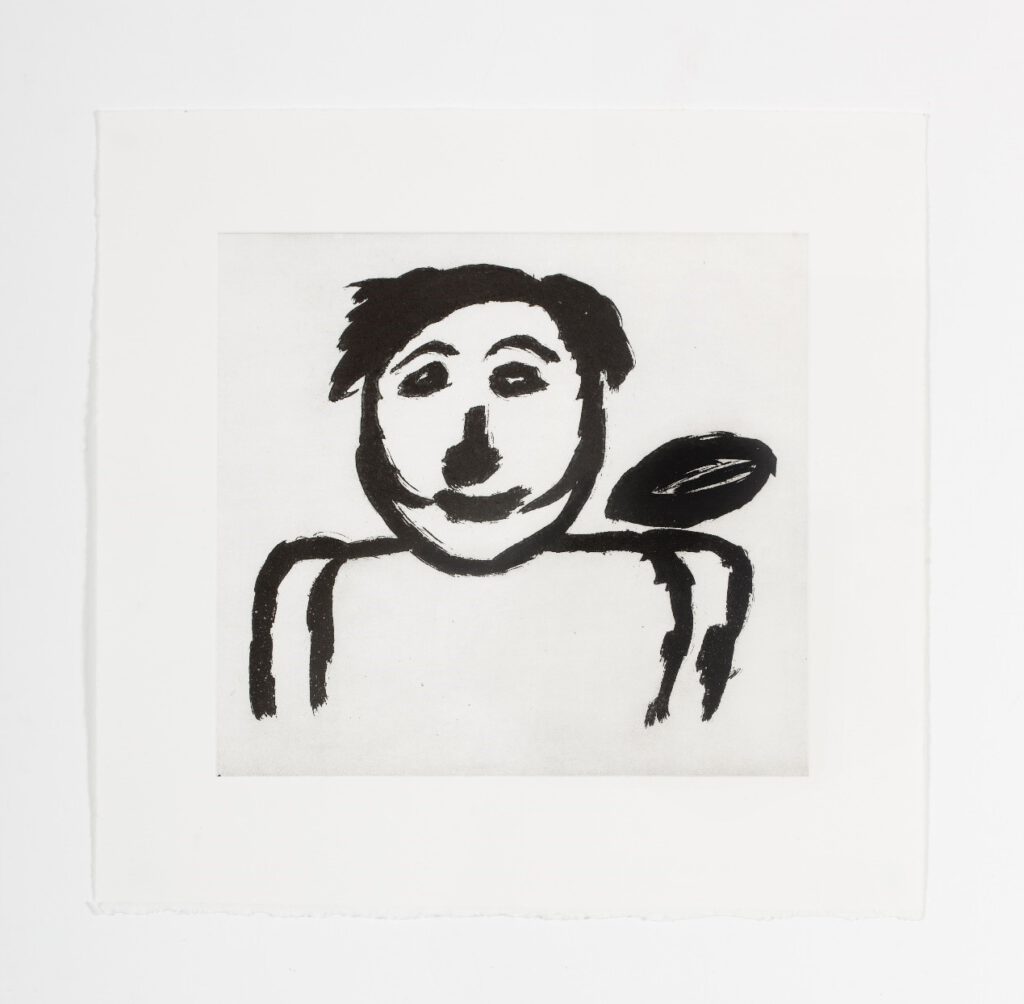
Yonatan Vinitsky: The Cruel King
“The Cruel King”, shown at Ashdod Art Museum, is Yonatan Vinitsky’s first museum exhibition, featuring a group of works in various mediums. The starting point for the exhibition was, says the artist, a consideration of the works as a whole, and while each stands independently, he stresses that all were made concurrently and especially for that show.
All the works were executed in techniques and mediums indicative of artistic tradition and Modernism (such as drawing, painting, sculpture and printmaking), but behind the polished veneer lies a complex, multi-layered maneuver that links the works together in subterranean ties, somehow uniting them. Each work generates a transformation of sorts, a conversion of some source material. And accordingly, each work follows a logic consistent with its original, which is derived from the wide array of culture’s products – a work of art, a cartoon, a newspaper clipping, a discarded note or a child’s painting found in the street – whether by producing a replica of it or by closely following its technique, color range, the way it is hung or the structure of that object; or still by replicating the manner of its original maker. All these Vinitsky transforms, without hierarchy, into elements of his own works: he appropriates and channels, alters and affixes, lowers and elevates.
The wish to decipher the process of decision-making of those who originally made them, says Vinitsky, is what motivates his work – the need to figure out how an artist works. In this Vinitsky always fails, he says, while still getting ever closer. That said, he never especially seeks those objects that eventually serve him as originals. Rather, he comes across them, he says, and recognizes them as his very own works. Thus Vinitsky builds a private index – an index based on cultural referents known and familiar only to him, which in his hands becomes a rigorous system of rules and dictates, a rigid and sanctified canon that allows for no deviation.
The exhibition’s title, “The Cruel King”, is taken from a sculpture by Aharon Ashkenazi, an Israeli sculptor active from the 50s until his death in the 90s. Ashkenazi’s presence reoccurs under many guises in the exhibition. One is a particular work that carries the exhibition’s title. Does “The Cruel King” function as a metaphor for the work of art or the artist’s position? Does it reference a popular realm of tales and fables? Does “The Cruel King” set apart its title work from all the rest, making it a guide for the exhibition? Or is it just an ironic quote, taken from different times and emptied of its original content?
All of the above – but perhaps none. For it seems that beyond the exhibition’s polished museum appearance it is marked by a pair of quotation marks, which are key to its understanding: Vinitsky points at the visibility of things and opens a fascinating discussion on the original and representation, on con and cliché, on awe, intention and choice, on the status of the work of art and the task of the artist, on the art establishment – on all of art’s elements.